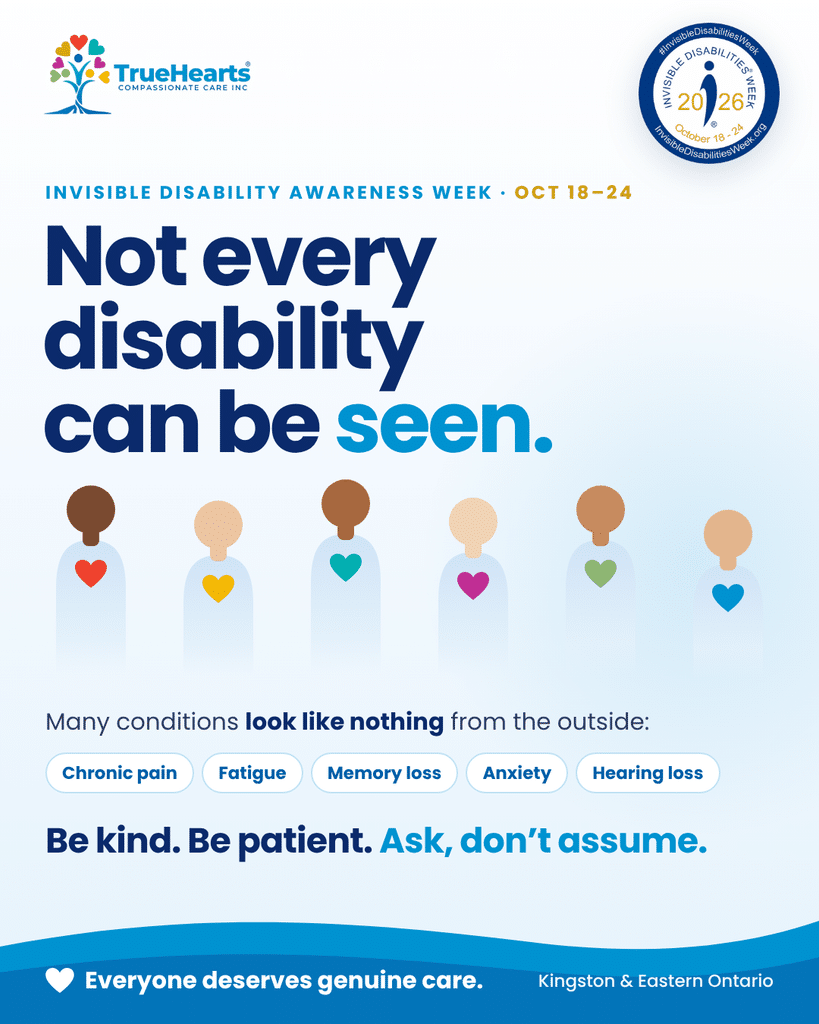
Invisible Disability Awareness Week | October 18–24, 2026
Not every disability is visible, and not every challenge can be understood simply by looking at someone.
A person may appear healthy and independent while quietly managing chronic pain, fatigue, memory difficulties, anxiety, hearing loss, or other conditions that affect everyday life.
Some days may be easier than others. Activities that seem simple to one person may require considerable effort for someone else.
That is why compassion, patience, and understanding matter.
Looking Beyond What We Can See
Invisible disabilities remind us that appearances do not tell the whole story.
We may not know what someone experiences when getting dressed, preparing a meal, completing household tasks, or participating in social activities.
Rather than making assumptions, we can listen, respect individual experiences, and ask how we can help.
Not everyone experiencing pain, fatigue, or anxiety has a disability. However, these challenges can be associated with conditions that substantially affect everyday functioning.
Compassion Begins With Understanding
At TrueHearts Compassionate Care, we believe genuine care means recognizing the person behind every need.
Our approach is guided by three values:
Compassion: Showing kindness and understanding.
Dignity: Respecting each person’s choices, independence, and individuality.
Reliability: Providing dependable support that individuals and families can trust.
Through our non-medical home care services, we support individuals and families with personal care, meal preparation, light housekeeping, companionship, and other everyday needs.
Our goal is to help people feel respected, comfortable, and supported in their own homes.
A Reminder for Our Community
As we recognize Invisible Disability Awareness Week, October 18–24, we encourage families, caregivers, neighbours, and community members across Kingston and Eastern Ontario to remember one simple message:
Be kind. Be patient. Ask, don’t assume.
We do not need to see someone’s challenges to treat them with understanding and respect.
Everyone deserves genuine care.
If you or someone you love needs compassionate, non-medical support at home, TrueHearts Compassionate Care is here to help.
TrueHearts Compassionate Care Inc. Serving Kingston & Eastern Ontario Website:https://trueheartscare.ca
Sometimes, the need for home care follows a hospital stay or a new diagnosis. Other times, the signs appear gradually: everyday tasks become difficult, independence is affected, or family caregivers find themselves stretched beyond their limits.
Whether you’re seeking care for yourself, supporting a loved one, or helping a patient transition safely home, finding the right support can feel overwhelming.
At TrueHearts Compassionate Care, we believe good care starts with understanding the person, their needs, and what matters most to them. That’s why we offer a free, no-obligation initial consultation to help individuals and families explore their home care options with confidence.
What Happens During Your Free Consultation?
Our initial consultation is a conversation, not a commitment. We listen to your concerns, answer questions, and explore:
Daily living needs: Personal care, mobility, meals, and household assistance.
Health and safety: Recovery after hospitalization, cognitive changes, disabilities, and everyday safety concerns.
Personal preferences: Independence, routines, culture, language, and individual choices.
Existing support: Family involvement, publicly funded services, and areas where additional help may be needed.
The goal is to understand your circumstances and identify suitable next steps. Where further assessment or individualized care planning is appropriate, we’ll explain the process before proceeding.
Personalized Care That Fits Your Life
No two people have identical needs, and their care shouldn’t be identical either.
TrueHearts provides personalized home care services, including personal support, companionship, post-hospital recovery assistance, dementia support, respite care, and culturally responsive care.
Our approach emphasizes appropriate caregiver matching, respectful communication, and care arrangements that support independence, comfort, and dignity. We don’t simply ask what someone needs help with. We also ask what matters most to them.
Complementing Existing Healthcare and Family Support
Home care often involves families, physicians, discharge planners, and community healthcare providers working toward a common goal: helping people remain safe and supported at home.
For individuals receiving publicly funded services through Ontario Health atHome, additional private care may help address needs beyond their scheduled support.
TrueHearts can complement these services by providing assistance with daily activities, companionship, recovery support, and respite for family caregivers.
For healthcare professionals recommending home care, we recognize the importance of individualized planning, clear communication, appropriate service boundaries, and continuity of support.
Our goal is to be a dependable part of the broader care network, supporting individuals and families while respecting the roles of their healthcare providers.
Genuine Care Begins with Understanding
Home care is about more than completing tasks. It’s about helping people maintain independence, respecting their choices, easing the responsibilities of families, and building relationships grounded in compassion and trust.
Whether you need a little extra help or more consistent support, the first step doesn’t have to be complicated.
Let’s start with a conversation.
Contact TrueHearts Compassionate Care for your free, no-obligation initial consultation.
Somewhere in Kingston today, an adult child is sitting at the kitchen table with hospital discharge papers, a phone number for a care coordinator, and a growing list of questions.
Does Mum qualify for publicly funded home care? How many hours will she receive? Who will help her in the evenings? What happens when I have to return to work? Can we afford additional private care?
These are questions many families face when a loved one begins needing assistance at home.
But here is something important every family should know: you do not necessarily have to choose between publicly funded home care and private home care. You can use both.
For families across Kingston, Amherstview, Napanee, Gananoque, and surrounding Eastern Ontario communities, combining publicly funded services with private home care can provide additional flexibility, continuity, and reassurance.
At TrueHearts Compassionate Care, we believe families deserve to understand their options before making important care decisions.
Let’s explain how both systems work, what each provides, and how they can complement one another.
Understanding Ontario Health atHome: Your Publicly Funded Care Option
Ontario Health atHome is the provincial organization responsible for coordinating publicly funded home and community care services for eligible Ontario residents.
Previously known as Home and Community Care Support Services, the organization helps individuals access appropriate care at home and in the community.
For example, if your loved one is preparing to leave Kingston General Hospital, Hotel Dieu Hospital, or a Providence Care facility, their healthcare team may involve an Ontario Health atHome care coordinator in planning their transition.
A care coordinator assesses the individual’s needs, determines eligibility, and helps arrange appropriate services.
What publicly funded home care may include:
Nursing care and other approved clinical services.
Personal support with bathing, dressing, and daily activities.
Physiotherapy and occupational therapy.
Speech-language therapy, social work, and nutrition counselling where appropriate.
Certain medical supplies, equipment, and specialized services.
These services are based on individual assessments and eligibility requirements. Approved services are generally publicly funded, although some equipment or related services may involve fees.
For many Kingston families, this support makes an important difference in helping a loved one remain at home.
Where Challenges Can Arise
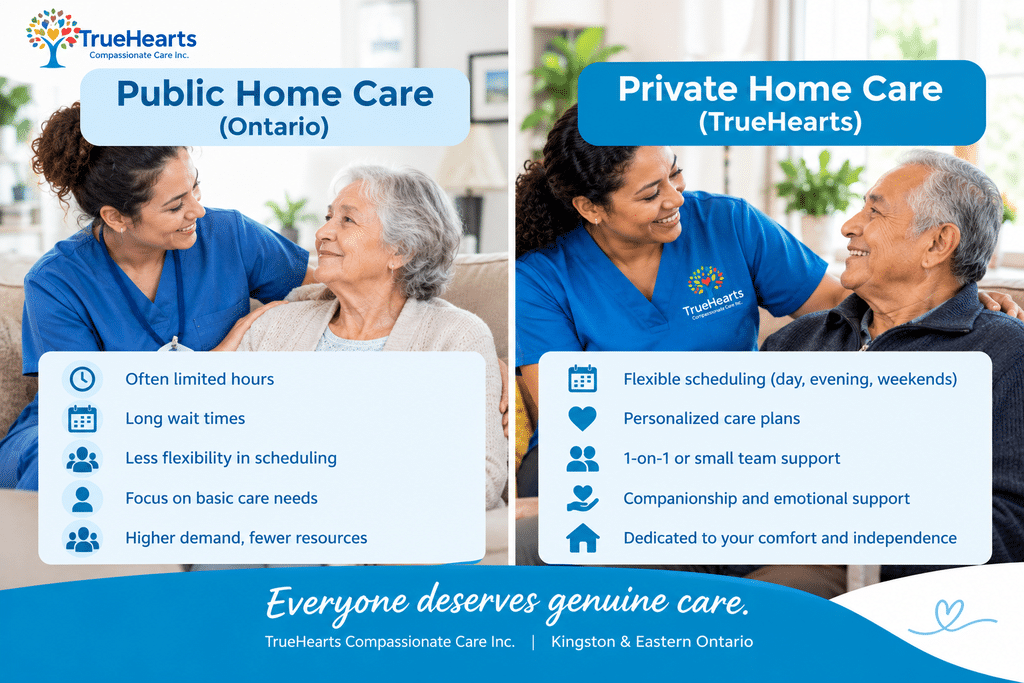
Although Ontario Health atHome provides valuable services, families may discover that the care approved does not cover every aspect of their loved one’s daily routine.
For example:
Care hours may not cover every need. A person may receive assistance with bathing and dressing but still require help preparing meals, getting ready for bed, or moving safely around the house.
Scheduling may not always match family routines. Publicly funded visits are arranged according to assessed needs and service availability. Families may have limited flexibility when requesting particular times or caregivers.
Some services may take time to arrange. Start dates vary according to urgency, eligibility, and provider availability. Families should confirm when approved services are expected to begin rather than assume support will be available immediately.
Additional household support may be needed. Companionship, routine housekeeping, transportation, and other non-clinical services may not be included in an individual’s funded care plan.
These challenges do not mean the public system has failed. They reflect the reality that publicly funded care is designed around assessed needs and available services, rather than every preference or household responsibility.
And for families in rural Frontenac, Lennox and Addington, or Leeds and Grenville, distance and transportation can add another layer of difficulty.
This is where private home care can provide additional support.
Where Private Home Care Fits In
At TrueHearts Compassionate Care, we believe home care should be personal, compassionate, and centred on the individual receiving it.
We understand that every household is different.
Some families need a caregiver for a few hours each week. Others require assistance following surgery, support for a loved one living with dementia, or someone to provide respite while a family caregiver takes a break.
Unlike publicly funded care, which is arranged according to eligibility and assessed needs, private home care allows families to purchase additional services based on their preferences, care requirements, and budget.
How TrueHearts Can Help
Flexible Care Arrangements
Families can discuss support during mornings, evenings, weekends, or overnight periods, depending on their needs and caregiver availability.
Personalized Caregiver Matching
We recognize that inviting someone into your home requires trust. Our goal is to match clients with caregivers who understand their care needs, preferences, personalities, and routines.
Assistance With Everyday Living
Our caregivers can support bathing, dressing, grooming, meal preparation, light housekeeping, mobility, and other daily activities.
Companionship and Emotional Support
For someone living alone, especially an older adult whose children live outside Kingston, regular companionship can provide comfort and meaningful social interaction.
Dementia and Cognitive Support
We provide compassionate assistance for individuals experiencing memory loss or cognitive changes, with attention to familiar routines, dignity, and safety.
Respite Care
We support family caregivers who need time to rest, attend appointments, work, or manage other responsibilities.
Post-Hospital and Nursing Support
We assist clients recovering from hospitalization, surgery, or illness. Where nursing services are required, qualified nursing professionals can provide appropriate care within their professional scope.
The important point is that private care does not have to replace publicly funded care. It can complement the services already in place.
The Combined Approach: What This Could Look Like for a Kingston Family
Imagine a Kingston resident returning home after hip surgery.
Her daughter works full-time and lives across town. Although she wants to help, she cannot be present throughout the day.
Ontario Health atHome has assessed her mother and approved certain personal support services.
The family decides to arrange additional private care through TrueHearts.
Here is an example of how their care plan could work.
8:00 a.m. — Publicly Funded Home Care
An assigned personal support worker arrives for an approved morning visit to assist with bathing, dressing, and other activities identified in the care plan.
10:00 a.m. to 2:00 p.m. — TrueHearts Private Home Care
A TrueHearts caregiver provides companionship, prepares lunch, assists with safe mobility, and supports the client’s daily routine.
If transportation is part of the agreed service arrangement, the caregiver may also accompany her to a follow-up appointment.
Evening — Additional Private Support
The family arranges evening assistance on selected days when the daughter cannot be present.
The caregiver helps with the evening routine and provides appropriate personal support.
Weekend — Family Caregiver Respite
On Saturday, TrueHearts provides several hours of care so the daughter can attend to her own household responsibilities and rest.
This is an illustrative schedule, not a standard Ontario Health atHome care package. Actual publicly funded visits and private services will depend on individual circumstances.
The advantage is that both services can work toward the same goal: helping someone remain safely and comfortably at home.
How to Combine Public and Private Home Care Without Paying for Unnecessary Services
One concern we frequently hear from families is the cost of additional care.
That concern is understandable.
Private home care is an out-of-pocket expense for many households, and families want to know they are making responsible financial decisions.
Our advice is to begin by understanding what support is already available.
Step 1: Request an Ontario Health atHome Assessment
If your loved one needs support, contact Ontario Health atHome or speak with the hospital discharge team.
You do not necessarily need to wait for a hospital admission before requesting an assessment.
Step 2: Understand the Approved Care Plan
Ask which services have been approved, how frequently they will be provided, and when they are expected to begin.
Step 3: Identify the Remaining Needs
Consider what happens outside the funded visits.
Does your loved one need help preparing dinner? Are they safe alone overnight? Who will take them to appointments? Does the family caregiver need a regular break?
Step 4: Arrange Private Care Around Those Needs
Rather than paying privately for services already covered, families can explore additional assistance for specific times or activities.
Step 5: Review the Arrangement Regularly
Care needs to change.
Someone recovering from surgery may require more assistance initially and gradually become independent. Another person living with a progressive condition may need increasing support.
A good care plan should be reviewed as circumstances change.
Let’s Build a Care Plan That Works for Your Family
You do not have to navigate Ontario’s home care system alone.
Whether your loved one is preparing for hospital discharge, already receiving publicly funded care, or beginning to need more assistance at home, understanding your options is an important first step.
At TrueHearts Compassionate Care, we are committed to helping families explore personalized home care arrangements that complement the support they already receive.
Serving Kingston and surrounding Eastern Ontario communities.
The phone call usually comes faster than anyone expects.
“Your mother is medically stable. We’re planning for discharge tomorrow.”
For a lot of Kingston families, that sentence brings two feelings at once: relief that a loved one is coming home, and a wave of quiet panic about what happens next. Who’s going to help her get up the stairs? Who’s watching the medications? What if something goes wrong on a Tuesday night when the clinic is closed and the roads are icy?
If you’ve had that call, or you are a physician, discharge planner, or care coordinator who delivers versions of it every week, this article is for you. We wrote it to answer the question we hear most often at Truehearts: what actually happens after discharge, and what can families do to get through it safely?
The Reality of Discharge in Kingston Right Now
Kingston Health Sciences Centre, across both the KGH and Hotel Dieu Hospital sites, does an excellent job of getting patients home. That’s genuinely good news — hospitals are not where people heal best, and most families want their loved one back in their own bed as soon as it’s safe.
But “safe to leave the hospital” and “fully supported at home” are two different things, and the gap between them is where most of the stress lives.
Ontario Health at Home (the public system that coordinates funded home care across the province) does important work assessing what a patient needs and arranging publicly funded support. What most families don’t realize until they’re in the middle of it is that funded hours are often modest sometimes just a few hours of personal support a week and it can take one to four weeks for those services to actually begin. For someone recovering from surgery, a stroke, or a serious illness, those first weeks at home are exactly when the most support is needed and, often, when the least is available.
This isn’t a criticism of the public system. Care coordinators and discharge planners across Kingston are managing enormous caseloads with real dedication. It’s simply the honest shape of the system as it exists today, and it’s why so many Eastern Ontario families end up searching for private help in the days right after a hospital stay.
Why the First Few Days at Home Matter So Much
Clinically, the period right after discharge is one of the highest-risk windows in a person’s entire recovery. This is when:
– Medication mix-ups happen most often, new prescriptions, changed dosages, and the simple exhaustion of being newly home all increase the risk of a missed or doubled dose.
– Falls are more likely, a person who was closely monitored in hospital is suddenly navigating their own stairs, a slippery Kingston driveway in February, or a bathroom that hasn’t been adapted for a walker.
– Warning signs get missed, a family without medical training may not recognize the early signs of infection, dehydration, or a complication that would send a trained caregiver straight to the phone.
-Family caregivers hit a wall , adult children juggling their own jobs and kids often try to cover the gap themselves, and burn out within days.
None of this means going home was the wrong decision. It means the first stretch at home deserves the same level of attention the hospital was providing, just delivered differently.
Where Private Home Care Fits In
This is exactly the gap Truehearts Compassionate Care was built to close.
We are a locally rooted home care provider serving Kingston, Napanee, Gananoque, and the wider Lennox and Addington area, and our entire model is built around one simple idea: care should feel like family, not like a transaction. For discharge specifically, that means:
– We can typically start care within 24 to 48 hours of a referral often before publicly funded hours even begin.
– We work alongside Ontario Health at Home, not instead of it. Many of our clients have both funded hours and private support running together, covering the gaps that funded hours alone can’t reach.
– Every client is matched with a caregiver based on personality and compatibility, not just a schedule, because a familiar face makes a genuinely stressful transition feel less frightening.
– We provide care for people of every age not only seniors including post-surgical recovery, dementia support, and family caregiver respite.
A Note to Physicians, Discharge planners, and Care Providers
You already know better than anyone that a good discharge plan on paper doesn’t always survive contact with a real household. We’d like to be a resource you can point to with confidence when a family’s needs outpace what funded hours can cover in those first critical weeks, a call away, responsive, and genuinely easy to work with. If you’d like to talk through how Truehearts fits alongside the care your patients already receive, we will welcome the conversation.
A Practical Checklist: Questions to Ask Before Discharge
Whether you’re a family member or supporting a patient professionally, these questions are worth asking before anyone walks out the hospital doors:
1. What specific tasks will the patient need help with in the first two weeks bathing, mobility, meals, medication?
2. Which medications changed, and is there a written, up-to-date list?
3. What symptoms should prompt a call to the doctor versus a trip back to the emergency department?
4. When do funded home care hours actually begin, and is there a gap to plan for?
5. Who is the one person the family can call, day or night, if something feels wrong?
That last question is often the one that matters most. Truehearts answers it simply: us, any time, day or night.
You Don’t Have to Figure This Out Alone
If you’re a Kingston family staring down a discharge date and wondering how you’ll manage the first few weeks, or a healthcare professional looking for a private care partner you can trust, we’d be glad to talk it through with you, free of charge and free of pressure.
Call Truehearts Compassionate Care at 613–305–8184, or visit trueheartscare.ca to book a free in-home consultation.
Everyone deserves genuine care, and that includes the hardest, most uncertain days, right after coming home.
When it comes to caring for ageing parents or loved ones with health challenges, many families in Kingston are discovering the comfort and peace of mind that live-in care offers. At Truehearts Compassionate Care, we’ve seen firsthand how 24/7 home support can make a meaningful difference. Here are the top five reasons families are choosing this option:
1. 24/7 Peace of Mind
Live-in care ensures that a trained professional is present around the clock, providing assistance at any hour of the day or night. Families rest easier knowing someone is always nearby to help in case of emergencies, late-night needs, or unexpected changes in condition.
2. Improved Safety at Home
Falls, medication mishaps, and wandering are major concerns for many seniors and those living with dementia. Live-in caregivers monitor daily routines, provide mobility assistance, and help manage medications—significantly reducing the risk of accidents.
3. Emotional Comfort & Familiarity
Being cared for in one’s own home fosters emotional security and stability. Familiar surroundings, cherished memories, and a personal routine all contribute to mental well-being and reduce feelings of confusion, stress, or isolation.
4. Personalized, One-on-One Attention
Unlike institutional settings, live-in care offers tailored support focused on a single individual or household. From dietary preferences to daily routines and cultural sensitivities, Truehearts Compassionate caregivers adapt care to fit your family’s unique needs.
5. Cost-Effective for High Needs Care
For clients requiring significant daily assistance, live-in care can be more affordable than multiple daily visits or long-term care facilities. With a live-in caregiver, you get consistent support without the cost of round-the-clock shift coverage.
Is Live-In Care Right for Your Family?
If you’re looking for a compassionate, consistent, and culturally sensitive care solution for your loved one, Truehearts Compassionate Care is here to help. Our caregivers are trained, trusted, and committed to bringing peace of mind into your home.
Discover home healthcare with Truehearts Compassionate Care. Our home healthcare services provide personalised, inclusive support. Book a free consultation now to bring comfort to your loved ones at home.